Key Facts
In 1938, as Nazi terror engulfed Austria and Jewish families desperately sought any way out, most foreign consulates in Vienna shut their doors. One did not. The Chinese Consulate, led by a quiet, principled diplomat from a small city in southern China, kept issuing visas — thousands of them — in direct defiance of his own superiors. His name was Ho Feng-Shan. His name means "Phoenix on the Mountain." And he was born right here, in Yiyang.
For nearly six decades, Ho's extraordinary act of courage remained a secret. He never spoke of it publicly. His own daughter didn't know the full scope until she wrote his obituary in 1997 and a historian contacted her, asking about a passing mention of the Gestapo. What followed was an 18-year investigation that revealed one of the most remarkable rescue operations of the Holocaust — carried out not by a Western power, not by a military hero, but by a poor boy from rural Hunan who became a diplomat.
From Poverty in Yiyang to the University of Munich
Ho Feng-Shan was born on September 10, 1901, in the countryside outside Yiyang, a city on the banks of the Zi River in Hunan Province. The Qing Dynasty was in its final years. His family was desperately poor. His father died when Ho was seven.
The trajectory of his life would have ended there if not for Norwegian Lutheran missionaries who operated in Yiyang at the time. They took the orphaned boy in and gave him an education. Ho proved to be an exceptionally gifted student. He entered the prestigious Yali School in Changsha (affiliated with Yale-in-China), and later attended National Central University.
In 1932, he earned a PhD in political economy from the Ludwig Maximilian University of Munich — in the very city where Adolf Hitler was ascending to power. Ho witnessed the rise of Nazism firsthand. He understood, perhaps better than most diplomats of his era, exactly what was coming.
Vienna, 1938: The Doors That Closed
In 1937, Ho was posted to the Chinese Legation in Vienna as First Secretary. He was popular in Viennese society — fluent in German, witty, well-read, frequently invited to speak on Chinese culture. Many of his friends were Jewish intellectuals.
Then, on March 12, 1938, everything changed. Nazi Germany annexed Austria — the Anschluss. Almost immediately, anti-Semitic violence erupted across Vienna. Jewish businesses were looted. Jewish families were dragged from their homes. The first Austrian Jews were deported to Dachau and Buchenwald.
Jews were told they could leave — but only if they could show proof of emigration: a visa to another country. Desperate families flooded foreign consulates. And one by one, the consulates refused them.
"Since the annexation of Austria by Germany, the persecution of the Jews by Hitler's 'devils' became increasingly fierce." — Ho Feng-Shan, memoir
One survivor, Eric Goldstaub of Toronto, later recalled visiting 50 foreign consulates in Vienna before finally obtaining a visa — from the Chinese Consulate, on Ho's orders.
The Shanghai Visa Strategy
Ho's solution was brilliantly strategic. He issued entry visas for Shanghai — a Chinese port city that, due to Japanese occupation, actually required no visa to enter. The harbor had no passport control. Anyone could land.
Ho knew this. The visas were, in his own words, for Shanghai "in name only." Their real purpose was to give Jews the documentation they needed to leave Nazi territory. Armed with a Shanghai visa as "proof of emigration," Jews could obtain transit visas to escape to other countries — Cuba, the Philippines, England, Palestine, the Americas.
Many did go to Shanghai. But many others used Ho's visas as stepping stones to safety elsewhere. His daughter, journalist Manli Ho, later explained: "My father's visa strategy succeeded in putting the Chinese port city of Shanghai on the map as a refuge of last resort."
Jews in concentration camps were released on the strength of these Shanghai visas. Families torn apart were reunited. Children who would have perished grew up to have children of their own.
Defiance at Great Personal Risk
Ho did not act with the blessing of his government. His immediate superior, Ambassador Chen Jie in Berlin, was adamantly opposed to issuing visas to Jews. Chen wanted good diplomatic relations with Nazi Germany and did not want to undermine Hitler's anti-Semitic policies.
When Chen learned that Ho was issuing large numbers of visas, he telephoned Ho and ordered him to stop. Ho countered by arguing that the Chinese Foreign Ministry's instructions were to maintain a "liberal policy" on visas. Chen sent an inspector to Vienna to investigate rumors that Ho was selling visas. The inspector found no evidence of wrongdoing — but placed a negative report in Ho's personnel file for insubordination.
Ho continued anyway.
When the Nazis seized the Chinese Consulate building — because it was Jewish-owned property — Ho rented a new office with his own money and continued issuing visas.
On at least one occasion, Ho confronted an armed Gestapo officer at gunpoint to protect a Jewish family. His friend Lilith-Sylvia Doron later recalled: "Ho, who knew my family, accompanied me home. He claimed that, thanks to his diplomatic status, they would not dare harm us as long as he remained in our home. Ho continued to visit our home on a permanent basis to protect us from the Nazis."
The Numbers
No one knows exactly how many visas Ho issued. The numbered visa records show that by June 1938, he had already issued visa #200. By October 1938, visa #1,906. He continued until May 1940, when he was recalled to China. Conservative estimates place the number at around 4,000 visas.
But the impact extended far beyond the visa recipients themselves. By making Shanghai known as a destination, Ho's strategy enabled an estimated 18,000 European Jews to reach the city — most of them from Germany, not Austria, since word had spread through Jewish networks that China offered refuge.
Forgotten, Then Found
After the war, Ho continued his diplomatic career for another 30 years, serving in Egypt, Mexico, Bolivia, Colombia, and elsewhere. He retired in 1973 to San Francisco, where he became a founding member of the Chinese Lutheran Church.
He never spoke publicly about Vienna. His personnel file carried a black mark for "insubordination." In 1972, he was accused of misappropriating $300 of embassy funds — charges his family maintains were politically motivated — and was denied a pension by the Republic of China government on Taiwan.
Ho died on September 28, 1997, at the age of 96. His story might have died with him.
But when his daughter Manli Ho wrote his obituary, she included the only wartime tale he had ever told her — confronting the Gestapo to protect a Jewish family. A curator researching diplomat rescuers noticed the obituary and contacted Manli. Curious, she began retracing her father's steps.
What she found, over 18 years of investigation, stunned the world. In 2001, Israel's Yad Vashem awarded Ho Feng-Shan the title of "Righteous Among the Nations" — one of the highest honors bestowed on non-Jews who risked their lives during the Holocaust.
Timeline
His Grave in Yiyang
In accordance with his wishes, Ho's ashes were returned to his hometown. In 2007, a gravesite was unveiled in Huilongshan Park (回龙山公园, "Meeting Dragon Mountain") at the peak of Huilong Hill in Yiyang's Heshan District.
The memorial was designed by Chinese-American architect Wenyi Wu, whose family has been friends of the Ho family for two generations. The design combines East and West: a dark green granite tombstone sits atop a stylized traditional Chinese burial mound with three concentric rings — the innermost representing home, the middle representing country, and the outer representing the world.
An inner wall of white marble carries two black stone insets: one with an epitaph by the renowned Chinese writer Yu Qiuyu, the other a poem Ho wrote for his wife. A high outer wall made of local river stones encloses the site, with an opening facing the direction of the Old Silk Road — a symbol of the passage between East and West that defined Ho's life.
Every year, on Qingming Festival, the city holds a commemoration ceremony at the gravesite, attended by officials, schoolchildren, Jewish community members, and visitors from around the world.
"I thought it only natural to feel compassion and to want to help. From the standpoint of humanity, that is the way it should be." — Dr. Ho Feng-Shan (何鳳山), 1901–1997
Visit Ho Feng-Shan's Hometown
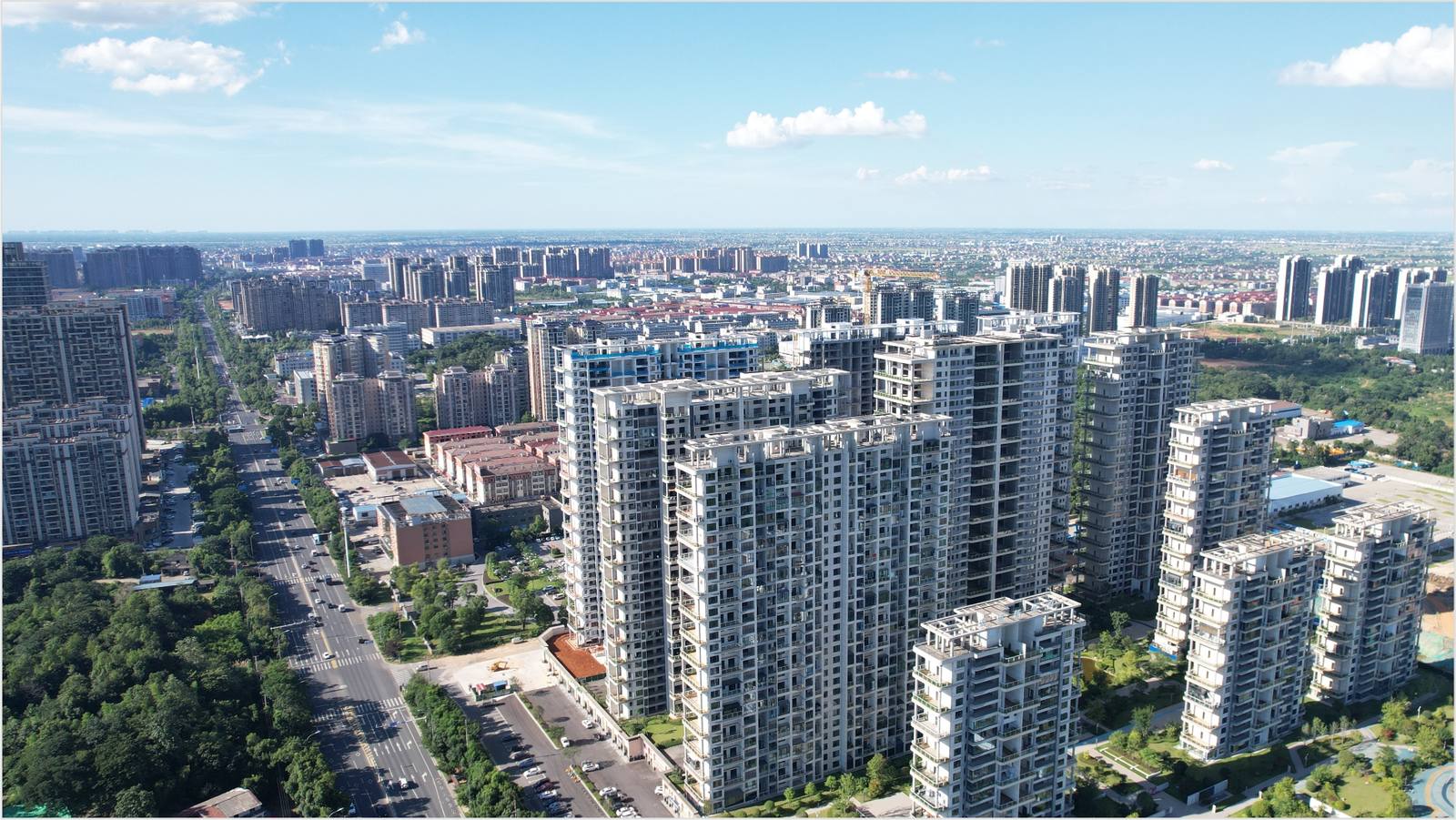
Yiyang is a walkable, friendly city of 4 million in Hunan Province. You can visit Ho's gravesite in Huilongshan Park, walk along the Zi River where he grew up, and experience the city that shaped China's most courageous diplomat.
Modern apartments in Yiyang start from $15,000 USD. Some visitors come for the heritage — and stay for the life.
Explore Properties in Yiyang →